Influential Leadership & Neurochemical Bartending
Jan 20, 2026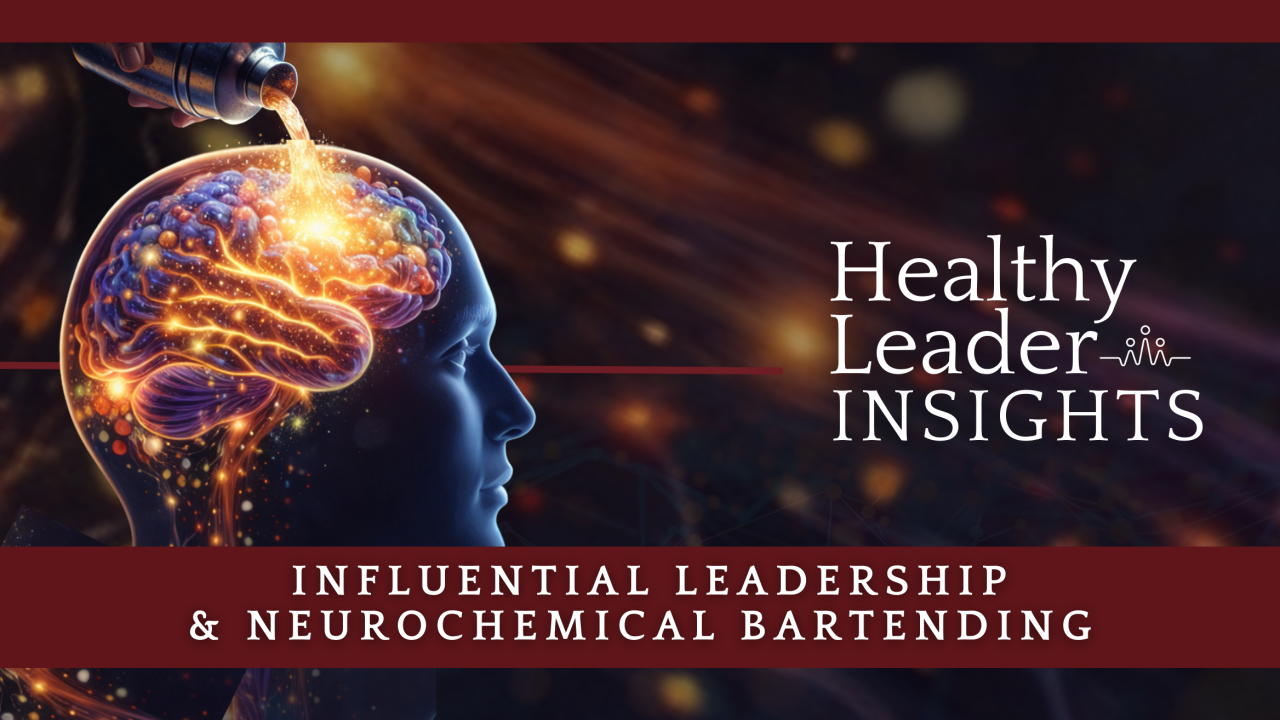
What you're serving before you've said a word
The chair scrapes loudly across the floor. Everyone hears it.
The leader leans back, arms crossed, jaw tight. The conversation hasn't gone the way they expected. Someone pushed back. Gently. Respectfully.
The leader doesn't interrupt. They don't argue. They just sit back. The room reads it instantly.
People stop talking. Someone glances down at their notes. Another person starts agreeing with whatever comes next.
The leader hasn't said a word, but the message is clear: This conversation is over.
THE BEHAVIOR WE TOLERATE
We've all been in that room. And we've all made the same silent calculation: it's easier to adjust than to address. So we do. We compensate. We work around it. We tell ourselves it's not that bad, or that it's just how they are under pressure.
But here's what we miss: the way a leader behaves doesn't just affect that moment. It shapes everything.
Dr. Michael Frisina states it clearly:
"Individual leader behavior is the single most important predictor of an organization's performance. Not technical skill. Not intellect. Not financial architecture or clinical excellence. Behavior."
In his award-winning article "Best Behaviors: Leveraging Neuroscience to Enhance Leadership Skills" (which earned the James A. Hamilton Award from the American College of Healthcare Executives in 2026), Frisina explains why. When you're managing stress from your upper brain, you manifest behaviors that drive performance. When stress overwhelms your capacity, you default to lower brain survival behaviors that limit effectiveness.
This isn't theoretical. It's observable. It's measurable. And it doesn't stay private.

YOU'RE THE NEUROCHEMICAL BARTENDER
Long before people process your words, they're already responding to your nervous system. Your pace. Your tone. Your level of steadiness or urgency. Influence begins there, whether you intend it to or not.
Frisina describes leaders as "neurochemical bartenders," constantly mixing and serving up brain chemistry to everyone around them.
Upper brain chemistry: Dopamine (motivation), serotonin (steadiness), oxytocin (connection). These neurochemicals trigger trust, purpose, and psychological safety. The outcome is clarity, collaboration, and performance.
Lower brain chemistry: Cortisol (stress), adrenaline (threat). These neurochemicals trigger fear and self-protection. The outcome is survival behavior: rigid thinking, defensive communication, relational withdrawal.
Your team drinks whatever you're pouring. Your physiological state enters the room before your strategy does. This is why two leaders can deliver the same message with completely different results. Same strategy. Different state. Different neurochemical impact.
LEARNING TO BARTEND
The trick to neurochemical bartending is to realize first that you are the bartender. You've got to influence your own state before you can influence anyone else's.
Dr. Frisina makes this clear in his landmark book, Influential Leadership: Change Your Behavior, Change Your Organization, Change Your Health Care. Personal leadership is the foundation. You can't lead others effectively if you haven't learned to lead yourself first.
And there are a lot of recipes out there. The Five Dysfunctions of a Team. The 4 Disciplines of Execution. The 5 Levels of Leadership. All valuable frameworks. All have helped countless leaders and teams.
What they have in common is this: they're all addressing three key influential behaviors - the way we communicate, connect, and collaborate with one another. Every meaningful leadership moment involves at least one of these capacities. And each one requires specific neurochemistry to function.

COMMUNICATION: MORE THAN WORDS—THE FULL EXPRESSION OF HOW YOU SHOW UP
Communication is more than what you say. It's the full expression of how you show up: body language, tone, presence, the space you create for others to think.
Here's what's critical: your state enters the room before your strategy does. The team's mirror neurons pick up your cortisol before you've finished your opening sentence. They're responding to what you're transmitting neurochemically, not just what you're saying verbally.
When you're in your upper brain, communication is clear and adaptive. You can frame complex ideas accessibly. You actively listen and reflect. You seek first to understand.
When cortisol and adrenaline take over, communication narrows. Your body signals threat even when your words don't. You talk over people. Listening becomes waiting to speak. Defensive explanations replace clarity.
Ineffective communication costs U.S. businesses $2 trillion annually in lost productivity and turnover. But that's not a skills problem. It's a state problem.CONNECTION: CREATING RELATIONAL COMMON GROUND
Connection goes beyond interaction. It's about identifying common ground: shared goals, values, humanity. It requires cultivating genuine curiosity, seeking to understand rather than just respond, and choosing to assume positive intent.
But connection has a neurochemical requirement: oxytocin, the bonding neurochemical. And oxytocin only flows when your nervous system feels safe enough to connect. When you're in lower brain territory, your system is producing cortisol, not oxytocin. You literally cannot generate the brain chemistry required for authentic connection.
In your upper brain, connection looks like genuine curiosity about what someone else is experiencing. You can stay present with discomfort without needing to fix it immediately. You build trust through attunement and consistency.
In your lower brain, connection becomes performative. You go through the motions while feeling emotionally distant. Staying open feels too risky or too exhausting, so you withdraw.
Research shows that employees who feel connected to their leaders are 3x more engaged and 5x more likely to thrive. But connection isn't a technique you apply. It's a neurochemical state you cultivate.COLLABORATION: MOVING TOGETHER, BEYOND ROLES
Collaboration is how you move with others. It means stepping beyond formal roles to offer unexpected support, building on others' ideas with "yes-and" rather than "no-but," and using capability alongside accountability to move challenges forward together.
This capacity requires the full neurochemical cocktail: dopamine for motivation, serotonin for steadiness, and cognitive flexibility from a regulated nervous system. When allostatic load pushes you into strain, those neurochemicals shift, and your brain prioritizes survival over shared problem-solving.
In your upper brain, collaboration looks like intellectual flexibility, shared ownership of problems, and the ability to sit in uncertainty long enough for better solutions to emerge.
In your lower brain, collaboration collapses into rigid positions and territorial protection. You dig in. Complexity feels threatening. Win/lose thinking replaces shared problem-solving.
Healthcare teams that collaborate effectively achieve 20% higher performance and save $2.71 for every $1 invested. But collaboration requires more than processes. It requires the neurochemistry of trust and openness.WHAT WILL YOU BE SERVING NEXT?
The leader who leaned back in that chair didn't mean to shut down the conversation. They were just tired. Stretched thin. But intention doesn't matter when you're the bartender. Your team still drinks what you pour.
This is the work: learning to recognize when your internal state is shifting the chemistry in the room. Not so you can fake it or muscle through, but so you can make a different choice.
Pause the conversation until you have capacity for it. Acknowledge when you're stretched. Build in recovery before it becomes crisis. Create the conditions for your upper brain to function before you ask it to lead.
Your team isn't experiencing your intentions. They're experiencing your neurochemistry.
You can't give what you don't have. And you can't serve upper brain chemistry to your team if you haven't learned to access it yourself.
The bartending starts with you.
If this resonates and you want to go deeper, come have a cocktail with us! I'm hosting a live conversation with Michael E. Frisina, PhD, LTC(R) United States Army on January 26th at 2:00 PM. We'll be talking through how this shows up in real leadership moments and what it actually takes to build capacity rather than rely on willpower. You can read Michael's full award-winning article, "Best Behaviors: Leveraging Neuroscience to Enhance Leadership Skills," and join the conversation here https://www.thehealthyleadergroup.com/expertforum.
