When Leadership Works, But You Don’t
Jan 08, 2026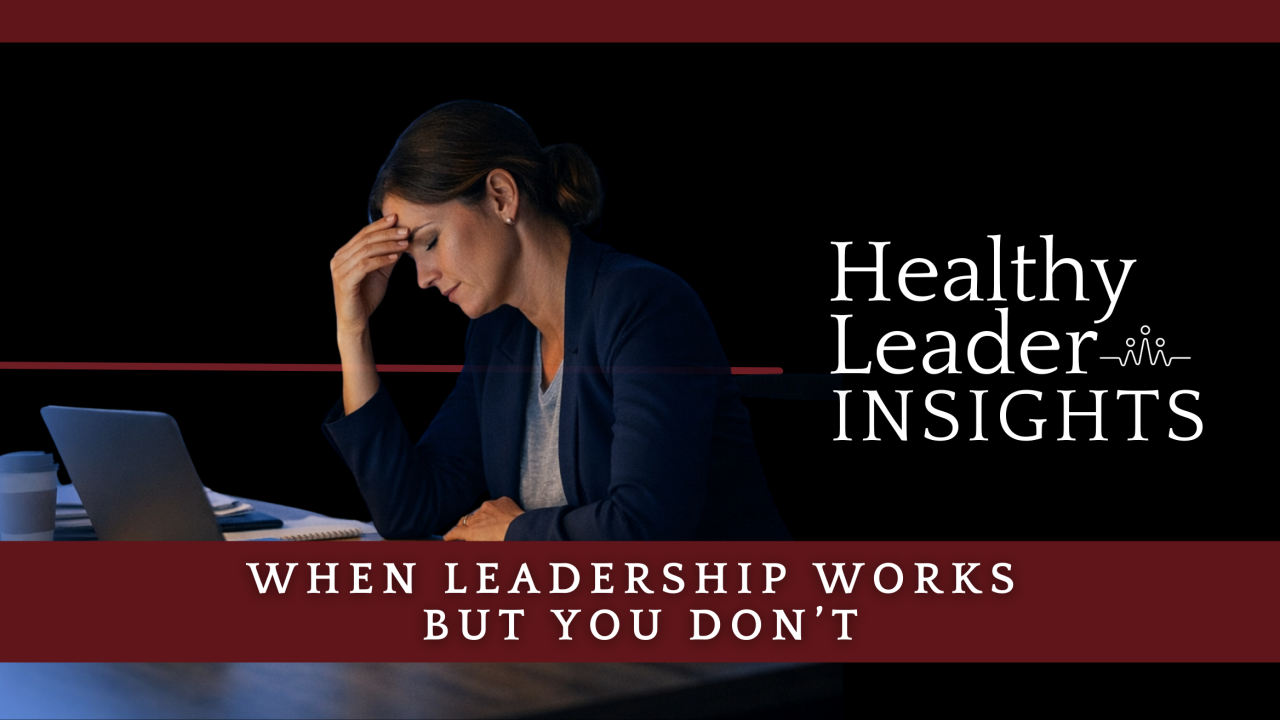
What it looks like when things are going well on the outside, and quietly misaligned on the inside
The doors to the fitness center opened early that morning. The room was already full, people talking, stretching, getting ready. I’d taught classes like this for years and knew the rhythm of the room, how to pace the hour, and how to meet people where they were.
But standing there before it started, I remember having a very specific thought:
I hope no one notices.
The night before, I’d had more wine than I planned. Not recklessly. Not publicly. Just enough to wake up foggy, with a headache, and aware that I wasn’t feeling my best. I knew how to work through it. Hydrate. Move. Focus. Stay professional.
The class went well. People were engaged. The energy was solid. Nothing was off.
The hour ended, and people went on with their day, including me.
And that was part of the problem.
My bad habit wasn’t so bad that it bothered anyone else, but it bothered me. I felt the wear of living out of sync with what I valued. I cared deeply about health, nutrition, and building strong, sustainable habits. I was someone others looked to for guidance. And yet, there I was, behaving in ways I knew weren’t healthy.
And I knew I wasn’t the only one.
I worked with high-level executives who were showing up, performing well, and carrying significant responsibility. From the outside, their lives looked successful and steady.
But beneath the surface, there was often strain. Sometimes it showed up quietly, a habit that wasn’t working anymore, or a low-grade sense that life looked like it should feel better than it did. Other times it was more obvious: tension spilling into relationships, short tempers at home, or the constant feeling of running on fumes.
Nothing was necessarily falling apart. But something wasn’t right.
Why Is This So Hard?
If this were just about knowledge or discipline, it wouldn’t be this difficult.
Most leaders I work with are capable and committed. They understand the importance of health, boundaries, and balance. Yet changing a habit or addressing what's quietly off can feel surprisingly hard.

Part of the reason change is so hard has to do with the external environment.
Modern leadership asks for sustained performance in environments that rarely slow down. Work follows us home. Technology keeps us reachable. Expectations are high, not just professionally, but personally. Many people are carrying responsibility in multiple domains at once, with very little space to recover in between.
But that’s only half of the story.
Another reason change feels so difficult is internal.
Even when people care deeply, have strong values, and know what matters to them, their brains are often working against sustained change.
The brain is designed to conserve energy and reduce perceived threat. It relies on familiar patterns and automatic responses, especially under stress, fatigue, or emotional load. Those patterns aren’t chosen because they’re healthy in the long term, but because they offer short-term relief or efficiency.
This is why knowing better doesn’t automatically translate into doing better.
Over time, this creates an internal tug-of-war. One part of us knows what matters. Another part keeps reaching for what feels manageable in the moment. And the harder life gets, the louder the default system becomes.
Understanding this doesn’t excuse the behavior. But it does change the conversation. Instead of asking, “What’s wrong with me?” a more helpful question becomes, “What capacity am I missing right now?”

The Common Ground Beneath It All
Most approaches to growth have more in common than they appear at first glance.
Different books, programs, therapies, and practices use different paradigms. Some focus on habits. Others on mindset, resilience, or wellbeing. Some emphasize discipline. Others awareness. But underneath those differences is a shared foundation.
Sustainable growth depends on capacity. Specifically, three core capacities that shape how we think, feel, and act - especially under pressure.
➡️ Mental capacity
Your ability to direct your thinking and attention. To notice what’s happening in your mind, question assumptions, shift perspective, and stay oriented toward what matters rather than getting pulled by every thought or distraction.
When mental capacity is strained, clarity narrows and reactivity increases. You sit down to focus on something important, but within minutes, you're checking email, glancing at your phone, thinking about three other things. Your attention won't stay where you point it.
➡️ Emotional capacity
Your ability to notice, tolerate, and regulate emotional experience. To stay present with discomfort, recover from stress, and respond rather than react, without suppressing or being overwhelmed by what you feel.
When emotional capacity is low, reactions replace responses. You snap at your kid over something small - a spilled drink, shoes left in the hallway - and immediately feel terrible. It wasn't about the shoes. You just didn't have anything left.
➡️ Physical capacity
Your ability to sustain energy, focus, and resilience through the body. Sleep, movement, nutrition, and recovery aren’t just health practices; they directly influence how well your nervous system functions.
When physical capacity is depleted, everything else becomes harder. It's 9 pm, and you're exhausted, but instead of going to bed, you pour a glass of wine and scroll through your phone. Not because you want to - because your system is too wired to settle, and you don't know another way to come down.

These capacities are not separate lanes; you master one at a time. They overlap and influence one another constantly. You can be strong physically and still emotionally exhausted. Mentally sharp and physically depleted. Emotionally aware but mentally overloaded.
Healthy leadership doesn’t require perfection in all three. It requires awareness of where your capacity is strong and where it’s thin. This is where self-leadership comes in.
Self-leadership is the practice of intentionally directing your thinking, emotions, and actions toward a desired result, especially when conditions aren’t ideal.
It’s not about fixing yourself. It’s about building enough internal capacity to live in alignment with what you value, even under real-world pressure.
Why This Matters Beyond You
Self-leadership isn’t just personal. It has ripple effects. How you manage your internal state shapes how you communicate, connect, and make decisions. This isn’t abstract. It’s physiological.
Human nervous systems are responsive to one another. Stress, calm, agitation, and steadiness are contagious. Research in social neuroscience shows that people unconsciously sync with the emotional and physiological cues of those around them - especially those in positions of influence.
- When mental capacity is strained, communication narrows.
- When emotional capacity is depleted, reactions replace responses.
- When physical capacity is low, patience and presence drop.
Over time, this affects trust. Collaboration. Psychological safety. Performance.
This is why leadership is never just about strategy or skill. It’s about the internal conditions from which those skills are expressed. Whether you’re leading a fitness class, a family, a team, or an organization, people experience you before they experience your ideas.
Self-leadership creates the internal steadiness that allows influence to land cleanly, without force, without burnout, and without quiet resentment.

That morning at the fitness center, nothing went wrong. The class was solid. The room had energy. People left feeling good.
And yet, I knew something needed my attention. Not because everything was broken, but because I didn't want to keep living slightly out of sync with what I valued.
Healthy leadership doesn't start when things fall apart. It starts when you decide that functioning isn't the same as fulfillment.
And that your inner life matters, not just for you, but for everyone you lead.